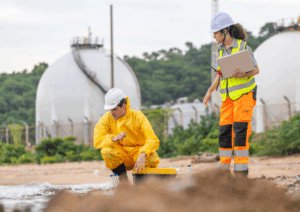
Contaminated soil can become a long-term environmental and commercial liability for industrial property owners, developers, and operators. Petroleum hydrocarbons, chemicals, metals, and other contaminants may remain in soil as a result of historical industrial activity, spills, leaks, or previous site use.
When contamination is identified, excavation and disposal may appear to be the simplest answer. However, complex sites often require a more considered approach.
Professional soil remediation services can help determine an appropriate strategy based on contamination characteristics, site conditions, future land use, and environmental objectives.
Why Soil Contamination Is a Complex Problem
Contamination does not always remain in a clearly defined area.
Depending on the contaminant and site conditions, pollutants can migrate through soil, affect groundwater, accumulate at different depths, or become distributed across a larger area.
Historical industrial sites can be particularly challenging because the original source of contamination may no longer be obvious.
Multiple contamination sources may also exist across a single property.
Understanding the distribution and characteristics of contamination is therefore essential before selecting a remediation strategy.
Excavation Is Not Always the Best Solution
Excavation can be an effective remediation option in certain circumstances, particularly where contaminated soil can be safely removed and appropriately managed.
However, removing large volumes of soil can involve significant transportation, disposal, replacement material, equipment, labour, and site restoration costs.
It can also disrupt existing infrastructure and business operations.
For larger or more complex sites, alternative or complementary remediation technologies may offer a more appropriate solution.
The right approach depends on the contaminant, concentration, depth, soil characteristics, site conditions, and intended future use of the property.
Selecting Remediation Technologies
Different contaminants respond differently to treatment.
Some remediation strategies focus on removing contaminated material. Others aim to treat contaminants within the soil or reduce their mobility or concentration.
Potential approaches can include excavation, treatment, containment, stabilization, or other site-specific remediation techniques.
Technology selection should be based on technical suitability rather than simply choosing the most familiar option.
A remediation strategy that works effectively at one property may not be appropriate at another because geological conditions, contaminant characteristics, groundwater conditions, or site constraints can be different.
The Role of Site Characterization
A strong remediation project depends on reliable information about the site.
Environmental investigations can help identify the location and extent of contamination and provide information required for remediation planning.
Site characterization may consider:
- Contaminant type
- Concentration
- Horizontal distribution
- Vertical distribution
- Soil characteristics
- Groundwater conditions
- Potential migration pathways
- Existing infrastructure
- Future land use
The quality of this information can directly influence remediation decisions.
Balancing Environmental and Commercial Objectives
Industrial remediation projects often have commercial pressures.
A property may need to be redeveloped, sold, returned to productive use, or brought into compliance with environmental requirements.
The remediation strategy therefore needs to address environmental objectives while also considering schedule, budget, site access, infrastructure, and operational requirements.
A technically effective solution that cannot be implemented within the site’s practical constraints may not be the most suitable option.
Managing Contaminated Soil During Site Development
Construction and redevelopment can uncover previously unidentified contamination.
Excavation activities may expose impacted soil that was not included in the original site assessment.
Having an environmental response strategy in place can help businesses manage unexpected findings without unnecessarily delaying the project.
Contaminated soil may require segregation, characterization, temporary management, treatment, or disposal depending on its properties.
This makes coordination between environmental specialists, contractors, engineers, and site management particularly important.
Long-Term Considerations for Remediation
Successful remediation should not only address the immediate contamination problem.
Businesses may also need to consider whether residual contamination could create future risks or restrictions.
Long-term site management can involve monitoring, controls, additional investigation, or other measures depending on the remediation strategy and site conditions.
This broader perspective can help property owners avoid treating remediation as a short-term construction exercise.
Professional Soil Remediation Services
TAS Environmental Services provides environmental remediation solutions for sites affected by contamination.
Professional soil remediation services can help businesses assess site-specific conditions, identify appropriate remediation strategies, manage contaminated materials, and move toward the intended future use of the property.
For complex industrial sites, the objective is not simply to remove contaminated soil. It is to develop a technically appropriate and commercially practical strategy that addresses the nature of the contamination while supporting the property’s long-term environmental objectives.